Ray Zone and the “Tyranny of Flatness”

ONE

Hillhurst Avenue, in the heart of Los Angeles’ Los Feliz Village, was, until a few years ago when a number of hip restaurants and shops opened, one of those quiet streets that begs you to cross mid-block on foot, with impunity. Today, you scramble for a parking space on the heavily metered streets. Set back from the bustle of the nearby restaurants is a barely noticeable apartment complex just north of Franklin Avenue. A gated, second story, cozy apartment on the west side of the street is both home and office to 3-D film scholar and 3-D photo buff Ray Zone.

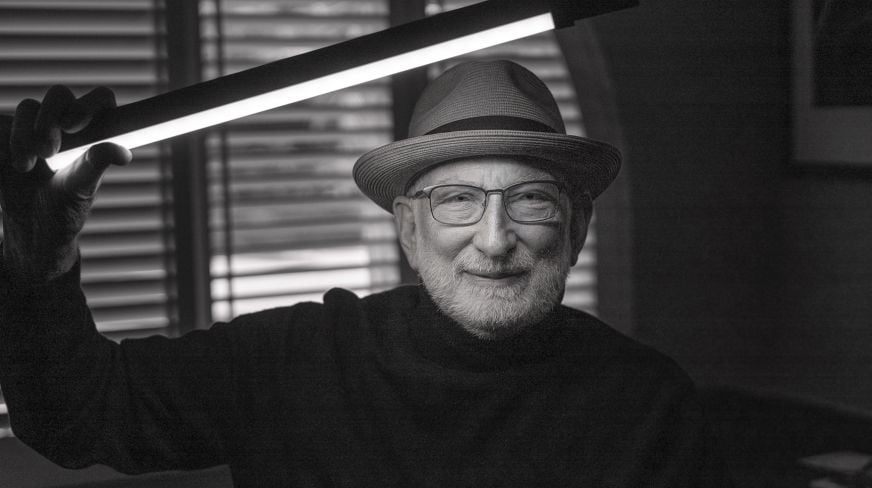
Ray Zone in 3-D. Got glasses?

Ray’s presence among the community of 3-D film fans is almost legendary. He has served as president of the Stereo Club of Southern California, a loose confederation of amateur and professional 3-D filmmakers, scholars and always-amiable, techno-nerd shutterbugs.

Stereo Club of Southern California link

Ray has written several books on the origins, history and technology of 3-D cinema, as well as numerous magazine articles on 3-D aesthetics and stereoptic theory and practice. He is also an accomplished creator of more than one hundred thirty 3-D comics.

Zone's 3-D conversion work for "League of Extraordinary Gentlemen."

I have known Ray for years and like many of my cinematography peers I have viewed his dedication to 3-D image creation with both awe and curiosity. The flat-screen, mainstream film community has read about and seen waves of interest in 3-D cinema technology ebb and flow, each predicted crest never quite reaching a discernible high water mark that left a lasting imprint—until Avatar.

James Cameron’s singular commitment to graft 3-D onto the cutting edge of digital technology, as well as his partnership with Vince Pace, has revolutionized a format that, though it popped up from time to time like a whack-a-mole, has for much of the recent decades largely been the domain of  quirky diehards, amateur 3-D film buffs, and quick-buck exploitation, grind and gore, skin-flick producers. (I suspect this will be challenged by a cadre of dedicated stereoptic-film fans who perceive themselves as keepers of the flame, but so be it). Now, suddenly 3-D digital filmmaking is not only the hippest of technologies but has so penetrated the consciousness of mainstream Hollywood, that it is unlikely that any “tent pole” movie in development will not seriously consider 3-D production, at least in the immediate future. Avatar is easily the largest grossing film in history, and the record opening of the 2-D to 3-D Alice in Wonderland has cemented the commercial viability of 3-D, D-cinema. A feature piece in the March 8 issue of The New Yorker written by staff critic Anthony Lane merely recognizes a phenomenon that has been growing for several years, strongly backed by a generation of 3-D computer-generated, animated features.

The New Yorker article link

A measure of Ray Zone’s prominence in the current writing on 3-D technology is the fact that Lane not only cites him early on in his New Yorker essay but he dips deeply into the content of Ray’s book, Stereoscopic Cinema and the Origins of 3-D, 1838-1952. It is no accident that Zone’s history freeze-frames on the eve of the 3-D Golden Age revival of the early 50s.

Amazon.com —Stereoscopic-Cinema-Origins-Film-1838-1952 link

Ray Zone’s History of 3-D Film.

Divided into ten chapters, the book traces the development of stereopsis from Charles Wheatstone’s stereoscope of 1833, up to the Festival of Britain in 1951—a century after the Great exhibition of 1851 that was the debut of the Crystal Palace. At the Festival, the feature film The Magic Box was premiered. This 3-strip Technicolor film, photographed by Jack Cardiff, is a biopic of William Friese-Greene, an English pioneer (putative at least) of color and 3-D cinematography. One of the conundrums of doing research on 3-D is the difficulty of separating myth from reality in this oft-times confusing and speculative history of cinema. So much of the paper trail for scholars consists of hyperbolic advertisements, as well as drawings for patents that document concepts rather than practicable systems.

imdb.com — The Magic Box link

Other chapters of Zone’s book detail the early development of stereography as it parallels the history of planar still photography. He devotes a section as well to the manic popularity for stereo-cards in the post Civil War home. Domestic viewing and collecting of stereo cards was made easy by the invention of a handheld viewing device by Oliver Wendell Holmes (a true stereo devotee).

A Holmes stereoscope.

The rapid introduction of sequential stereo cards that featured recurring characters in staged settings became a true forerunner of narrative cinema. A chapter on the work of famed photographers such as Marey, Watkins, and Muybridge, whose stereo landscapes and animal studies are much better known in flat versions, leads directly to William Kennedy-Laurie Dickson’s exit from Edison’s labs when the great inventor refused to adapt his still-new film technology to Dickson’s dream of large screen popular exhibition. There are also fascinating tales of how 3-D films, though still a curiosity, developed alongside flat ones in the early 20th century. The culmination of contending concepts came with the release of the first feature length 3-D film, The Power of Love, in 1922.

imdb.com — The Power of Love link

The emergence of sound films in the late 20s may have overshadowed growing developments in 3-D technology in the public eye, but new camera and projection systems continued to emerge and Zone presents several of them in considerable detail. One surprising story he describes is of Gregg Toland’s projection of film tests at Grauman’s Chinese Theater in 1935 with producer Sam Goldwyn, of footage shot with a purported 3-D camera built by William Alder, an associate at Cal Tech. Most scholars dispute that this test was true 3-D, but some historians aver that Toland developed his ideas for deep focus cinematography from this time.

TWO

For many of us today, the golden era of 3-D films was reached in the early Fifties when more than four dozen mainstream feature films were exhibited, some made by distinguished directors like Hitchcock (Dial M for Murder was released in 2-D), Walsh, and Sirk, as well as the monocular Andre de Toth, director of the seminal House of Wax. What Ray Zone’s book presents is a parallel window into film history that validates stereoptic filmmaking as an exciting alternative to the conventional one. He echoes all of the high points in motion picture development that planar histories do, but Zone’s perspective is a discourse on what was ultimately a road not taken—possibly because of the difficulties in achieving reliable exhibition guidelines and consistent quality control of far-flung screens. What became clear to me during a series of one-on-one conversations with Zone is that, despite the marginalization of 3-D filmmaking as a “transgressive” mode of crude and in-your-face gimmicks in the interim period from the 60s until the middle of this decade, there is an extremely rich earlier history to explore. Had several of the purely technological obstacles been overcome as much as eighty years ago, our whole notion of film history and grammar would be different today. Many of the classic films that now constitute our cultural heritage would possibly exist in a format and a dimension that Ray calls the “z” or “immersive” axis. The sense of an exciting format not yet realized is clear, even as far back as a 1949 essay written by the Great Russian filmmaker Sergei Eisenstein.

Sergei Eisenstein, photo by Barre, 1930.

In an essay for the Penguin Film Review issue of January, 1949 (his last published work) Eisenstein begins with a question which he then answers himself:

Nowadays one meets many people who ask: “Do you believe in stereoscopic cinema?” To me, this question sounds as absurd as if I were asked: Do you believe that in nought hours it will be night, that the snow will disappear from the streets of Moscow, that there will be green trees in the summer and apples in autumn?”

Expressed in a less poetic metaphor, Eisenstein asserts that this is a “no-brainer,” that there is no real argument to be made against stereoscopic cinema. He further predicts that soon large-scale stereoscopic films will be ubiquitous. He continues:

But why are we so certain of this? Because, in my view, the only vital varieties of art are those which, of their very nature, are an embodiment of the hidden urges existing in the depths of human nature itself.

Eisenstein is not arguing here for a cinema of stereopsis based on any commercial designs such as the ones that came a few years later when Hollywood trotted out 3-D to get people away from their new TV sets. His argument is not only an aesthetic one, but an organic one—that we live and breathe in a stereoscopic world. He admits that all cinema is in fact a conceit, that 2-D planar cinema has not only prevailed for a century, but that it is clear to all of us who read film history, that a rich and almost ritualistic grammar of imagery has been developed to exploit the inherent limitations of flat screen movies. Eisenstein’s views for a future of 3-D cinema may have been based on a recent viewing of director Aleksandr Andriyevsky’s 1946 film of Robinzon Kuzo, the world’s first sound and color 3-D feature, using an auto-stereoscopic (no glasses) process. It employed rear projection onto a special screen constructed of a dense grid of parallel copper wires:

imdb.com — Robinzon Kruzo link

Eisenstein explains that:

…though we know quite well that they [all films] are no more than pale shadows, affixed by photochemical means on to kilometers of gelatin ribbon which, rolled on to separate reels, and packed into flat tins, travels from one end of the globe to another, giving spectators everywhere the same compelling illusion of their vitality.

This observation really gets to the heart of the dilemma of both 2-D and 3-D. While there is much emphasis made on the correspondence of depth perception in stereo cinema to that of nature, Eisenstein understands that just as in planar cinema, all movies are a trope, an illusion.

THREE

Further reading on stereopsis in cinema reveals just what an elaborate sleight of hand depth perception is—or rather, a sleight of inter-ocular intervals with lenses— that the degree as well as the quality of apparent depth is created and altered by the filmmaker at his discretion, that the conceit of 3-D filmmaking is not as simple as just limning the human eye. This became clear to me on the human level of biology as I read one of the essays that Zone had written for a recent issue of Stereo World. It is called “Stereorthoptics: Notes on ‘Stereo Sue’ Barry and Some Unknown Champions of Binocular Vision Therapy.” Susan Barry is the subject of a case study done by Dr. Oliver Sacks, the eminent neurologist and best-selling author whose stories have been made into Hollywood movies, the most noted of which is Awakenings, a film in which Robin Williams plays a character based on Sacks’ work.

Dr. Oliver Sacks.

Sacks’ essay on Barry is in the June 19, 2006 issue of The New Yorker. Barry was born, as is more than 4% of the general population, with a condition called strabismus, a defect of the eyes that is either esotropic (inner turning) or exotropic (outer turning). The two eyes are not able to achieve fusion, the simple resolution of a point in space that allows the distance between the two eyes (which see slightly different images) to resolve into the single image that creates depth perception.

Dr. Susan Barry.

More amazing, another 20% plus of the population suffers some difficulty in rendering full stereopsis. Here is an abstract of the Sacks essay. If you are a subscriber you can access the full piece (this is the new “for profit” bent the internet is taking for archived information that until recently was available for free).

The New Yorker article link

However revealing the essay is, and Sacks is an exciting writer, the full story is told by Barry herself in her recent memoir Fixing My Gaze.

Amazon.com — Fixing My Gaze: A Scientist’s Journey Into Seeing Three Dimensions

Here is a brief description of the book from Publisher’s Weekly:

Barry, a neuroscientist at Mount Holyoke College, was born with her eyes crossed and literally couldn’t see in all three dimensions. Barry underwent several surgeries as a child, but it wasn’t until she was in college that she realized she wasn’t seeing in 3-D. The medical profession has believed that the visual center of the brain can’t rewire itself after a critical cutoff point in a child’s development, but in her 40s, with the help of optometric vision therapy, Barry showed that previously neglected neurons could be nudged back into action. The author tells a poignant story of her gradual discovery of the shapes in flowers in a vase, snowflakes falling, even the folds in coats hanging on a peg. After Barry’s story was written up in the New Yorker by Oliver Sacks, she heard from many others who had successfully learned to correct their vision as adults, challenging accepted wisdom about the plasticity of the brain.

But there is no story as immediate as that of the narrator telling her own. Here are three YouTube videos of Barry in a lecture. She speaks from a lectern simply and directly with only a few projected slides, most charming of which shows her as a two year old with strabismus, shortly before a series of three operations that corrected her condition on a physiological level, but left her in depth limbo for another 4o plus years. It is an amazing story, not only as a human-interest narrative but also for filmmakers who want to think that the future of 3-D movies is some kind of an ordained inevitability. Here is part one:

In case you think that you now have a grasp of this story and are tempted to move on— don’t. Parts two and three of her talk are riveting and expand the dramatic turn of this visual adventure:

And part three presents the magical discovery of what stereopsis feels like to a previously monocular or ambi-ocular person:

In a June 26, 2006 interview with Barry and Oliver Sacks, NPR journalist Robert Krulwich follows the progress of Barry’s journey into stereopsis. You can hear the conversation by clicking on the “listen” box:

NPR.org – “Going Binocular: Susan’s First Snowfall” link

Barry’s description of “seeing” the steering wheel of her car hanging in space and of watching snow fall, made me recall an incident from my own life. I am not compromised in depth perception, or I don’t think I am, though I am now tempted to get tested with the cards Barry discusses.

I grew up in Los Angeles and as a child had never seen snow fall. At twenty, I was studying in Innsbruck, Austria, the autumn before the 1964 Winter Olympics were hosted in the Tyrolean capital. One October morning, I awoke to see the season’s first snowfall. Rushing outside, barely dressed, I looked up to watch the display. I felt an ecstatic shudder course through me as I saw thousands of snowflakes descending toward me against the early morning grey sky. I only began to understand this frisson later in the day. All my life I had experienced snow falling only in the abstraction of the movies—as planar images. Even in film angles with the camera pointed into the sky, the rush of snow had always appeared on the movie screen like dots dancing on a flat surface. Here, in real life, I now saw the fragile flakes cascade down toward my face, in discrete sizes, spacings, and speeds, falling, spinning, each one like a living being. I’ve never forgotten that rush of emotion.

Just recently, while I was filming a night exterior scene in Nashville, the crew prepared for a rain scene with towers and hoses set up outside a music honky-tonk. I had lit the set with a strong backlight in order to highlight the rain. Suddenly, it started to snow, slowly at first, then in a veritable torrent. The snow presented a tremendous problem for scene-to-scene matching—but I found myself as excited as a child at how magical it appeared. The backlight I had done for the now delayed scene, picked out the snowflakes, not just by defining white arcs in the night sky, but deep into space, like dancing curtains of light, softly, silently falling to the ground. I remarked at how beautiful it was, even as the ADs and script supervisor worried about the continuity problem. To my disappointment (since the snow scene will not appear in the final cut of the film) my friend Alex Nepomniaschy reshot it with rain towers a few weeks later. But I know that when I do the final grading of the film, I will always “see” the snow falling, defining a deep 3-D space that is otherwise hidden in the void and black flatness of night.

FOUR

Looking around Zone’s living room as we talked I couldn’t help but notice that the walls were lined floor to ceiling with books. A clearly eclectic reader who says he embraces the polarities of high and low culture, I spotted novels by Roth, (a favorite) De Lillo, Foster Wallace, Maughan, Huxley, Balzac. As expected there are many volumes of film criticism and history including tomes by Pudovkin, Eisenstein, Bazin, Spottiswoode, Tarkovsky, and Kracauer. Sartre, Camus, and Walter Benjamin are also present. Sandwiched between two bookcases is a rack that displays many of the 130 plus comics he has produced, anaglyph viewing glasses hanging loosely from the shelf. Such eclectic curiosity causes me to nod approval. I explain to him that it is this same sense of eclecticism that I strive for in the essays on this site, a kind of arts salmagundi, even though some readers tell me I should stick to film. I tell him that for us as filmmakers all the arts are relevant. The so-called “Seventh Art”—film— so named in 1912 by Italian intellectual Ricciotto Cannudo, is the synthesis of the six Hegelian arts. These art forms are our lifeblood and we need embrace all of them, not just out of obligation, but hopefully out of true love. I’m not quite certain where 3-D comics fold into this rarefied equation, but as a comic collector in my pre-teen years, I know I envy Ray Zone’s collection.

Even though I have not yet completed reading his compendious book on the origins of 3-D cinema, Ray gives me even more articles he has written recently. I suggest that it must be gratifying to see what has happened to 3-D filmmaking in the past five years and what a validation of his dedication to the format it must be—that filmmakers and producers everywhere are jumping onto the 3-D bandwagon. The Anthony Lane piece, I suggest, is just the beginning of serious, and popular, writing to come.

In fact, Ray’s deep knowledge of 3-D history is only part of his knowledge set. An inveterate 3-D photographer himself, he shows me his new Fuji 3-D camera.

Fuji 3D Camera.

As he talks he snaps a flash photo in the dim room, then turns to show me the screen. To my surprise I see myself in 3-D, without having to wear glasses; the viewing screen is lenticular. When I get home I promptly go to the Fuji website and search for the camera:

Fujifilm.com — 3-D Camera link

Here is a pdf that may tell you more than you ever want to know about 3-D still cameras, with technical terms such as variable inter-ocular and hyper and hypo modes running amok:

Fuji 3-D Presentation.pdf link

The realization that I could possibly join this fraternity of 3-D shutterbugs, even as an elder novice, caused me to think back on cinematographer Karl Struss and his Stereo-Realist camera, the longtime bestselling 35mm 3-D camera that he took to Italy late in his career. He and Ethel lived in Rome for several years when he was photographing 3-D movies that were barely released in this country.

Photo-Realist 3D camera, made by the David White Company 1947-1971.

Here is detailed history of the Stereo-Realist camera:

Wikipedia.org — Stereo Realist article link

FIVE

Some colleagues have accused me of being a Luddite because I continue to avow a deep-seated love for 35mm film, both in image capture at the production stage and in finishing with cut negative and photochemical answer printing. I know that actually being able to accomplish this is becoming an ever more elusive pursuit. But I am not so certain that planar 2-D movies, even photo-chemically finished ones, are on their deathbed. I will address this issue in the future as part of an essay on the inherent differences in film grammar and style between 2-D and 3-D movies, and why I think stereo is not the inevitable sole future (despite James Cameron’s and Jeffrey Katzenberg’s fantasies). But at this moment, I am excited by the challenge of how to step up to stereopsis in movies, especially in the kind of movies I have spent a career choosing to do—intimate, tightly dramatized stories with a small cast, few locations (primarily interiors), devoid of elaborate visual effects and eschewing rapid-fire action and stunts.

I have put on hold my reading of cinematographer Jack Cardiff’s 1996 memoir Magic Hour, intended subject of an upcoming blog essay, in order to write this piece on 3-D movies. Cardiff was the first cinematographer to use a 3-strip Technicolor camera in England, on a wartime documentary called Western Approaches. He chose the same camera system a few years later for several classic Michael Powell films including Black Narcissus and The Red Shoes. (According to Rob Hummel, who worked with Cardiff late in his career, the English crews referred to the Technicolor camera housed in its sound blimp—a package of 570 lbs.—as “the magic cottage”).

Cardiff also had a distinguished career as director, with more than a dozen credits. His most satisfying film in this role is the black and white feature Sons and Lovers, adapted by Gavin Lambert from an early D.H. Lawrence novel. For his work on this film cinematographer Freddie Francis received his first Oscar. It is a tense and dramatic film, photographed mainly in small sets. It was released in 1960 at the time of a real slough in 3-D production. I can’t help but wonder what Cardiff and Francis, two of the greatest cinematographers in cinema history, would have done if they had elected to film Sons and Lovers in 3-D. Cinema stereopsis may have had a far different history during the following half century had they done so, and my generation of film school brats would perhaps now not be looking at 3-D, here in our mature years, with both intrigued and ambivalent eyes.

Added Note: Just prior to posting this essay, a report was published in the March 14, 2010 New York Times Magazine, “Issues with a Fix for Kids with Issues: The Fight Over Vision Therapy.” It investigates the possible correlation between many developmental “issues” such as A.D.H.D. and problems with vision, such as convergence and accommodation. While not directly relevant to the question raised in my blog this week concerning stereopsis and strabismus, it does present the debate between proponents of behavioral optometry and  those of traditional psychic and pharmacological therapy—a fascinating article especially if you have children with developmental “issues.”

The New York Times article link

Photo by Samantha Contis for the NY Times.

Wendy Hiller, Dean Stockwell and Trevor Howard in "Sons and Lovers," 1960.

Frank Hurley: The “Endurance” and Paget Color

The nineteenth century era of colonial exploration and discovery fronted a desperate race among the leading world nations to take a stake in the rapidly diminishing spoils of a shrinking planet. Children of every generation since that time have thrilled to accounts of the adventures spawned by this headlong rush to claim the yet unknown parts of planet earth. But there is one such story that once it caught fire in the public imagination, has never burned out. It is more than a tale of colonial greed. It is one of sacrifice and heroism and its hold on the public imagination is due largely to this young man:

Frank Hurley, self portrait, 1911, age 26.

The story of Ernest Shackleton’s third polar expedition, (the “Imperial Trans-Antarctic Expedition 1914-1917”) an attempt to walk across the frozen continent and its polar region with  a crew of 27 (a failed venture like his two previous attempts) has been the subject of many books, feature films and documentaries.  Within several years of the mission’s end many members of the crew published breathtaking memoirs of struggle, camaraderie, life-threatening deprivation, and rescue after months spent on Elephant Island, a barren, rocky outcropping nearly 800 miles over treacherous seas from the nearest habitable outpost, a Norwegian whaling station on South Georgia Island.

It was Shackelton and five hand-picked members from the crew that sailed in a re-rigged lifeboat from the lost mother ship, Endurance, who made that unbelievable voyage to find help, even as Hurley and 21 of the crew waited for over three months, somehow surviving on diminishing supplies of seal and penguin while they huddled against the ferocious elements in shelter that was not much more than two overturned small boats.

The James Caird launches from Elephant Island, April 24, 1916 (Easter Sunday).

Most of the record of this heroic adventure, starting with its promising departure from Plymouth, England on August 8, 1914, only four days after the outbreak of WWI, until its end, as all of the still stranded team members were transferred aboard a Chilean vessel, the Yelcho, almost two years later, might easily have disappeared into the archives of government historical societies. Such was the fate of many such contemporaneous ventures. But none of those expeditions included as documentarian a photographer with the technical and artistic acumen nor  the courage of Frank Hurley.

When Englishman Shackleton engaged Hurley, the young Australian was already a veteran of the Mawson Antarctic expedition of 1911-14. Born in a suburb of Sydney on October 16, 1885, Hurley was 26 when he joined the Mawson expedition. Hurley had run away from home at age 14 and had found work on the nearby Sydney docks. Within three years he bought his first camera, a Kodak Box Brownie, and taught himself the rudiments of photography. In a much later diary entry Hurley recalled the thrill of immersing himself in darkroom chemicals: “From the time I first gazed wonderingly at the miracle of chemical reaction on the latent image during the process of development, I knew I had found my real work and a key, could I become its master, that would perhaps unlock the portals of the undiscovered world.” Such unbridled enthusiasm sustained him throughout his decades long career.

Shackleton had heard of Hurley’s work with Mawson, had seen a film he had made of the venture, and offered him the position of the expedition’s photographic and motion picture documentation.  Hired sight unseen, Hurley met Shackleton in Buenos Aires where the Endurance was making its final preparations. For Shackleton, much of the investor money entrusted to this expedition was to be recouped by sales of photos and a film of the venture. Hurley was thus a key player.  Aware of Shackleton’s desperate need for a photographer for this polar venture, Hurley was able to negotiate a 25% participation on all film revenues.

So thorough was Hurley’s commitment to recording the voyage and trek that only months after his rescue, he returned to South Georgia Island for additional photos and filming, to record the only part of the expedition that he had missed while trapped on Elephant Island. You can look at a number of books and films spawned by Hurley’s work by scrolling to the bottom of the page on this site:

Coolantarctica.com — Ernest Shackleton Trans-Antarctic Expedition link

There are also numerous accounts here about Shackleton and the complete expedition. But there are two that have Frank Hurley’s life and work as their focus. The first is a biography by Alasdair McGregor, currently out of print:

Frank Hurley with his cine camera.

The other is South With Endurance, compiled from the archives of several historical societies in England and Australia and with essays by Shane Murphy, Gael Newton, and Michael Gray. This volume is rich with several hundred pages of Hurley’s black-and-white photographs as well as a selection of his Paget color plates. There are also sections on his techniques and an equipment manifest and description. It has provided much of the research for this essay:

Amazon.com — South Endurance: Shackleton’s Antarctic Expedition link

The Endurance left the port of Buenos Aires on October 26 and reached the final supply outpost of Grytviken on South Georgia Island on November 14. It steamed out of Cumberland Bay on December 5, 1914 headed for the Weddell Sea and the Antarctic continent. A second ship, the Aurora, would retrieve the expedition trekkers at Cape Evans on the Ross Sea, on the other side of the continent. But within a day of raising anchor the ominous warnings of early pack ice became a reality and progress was slowed. The hull of the Endurance, still on its maiden voyage, was built to crush through most ice. But by February 14, 1915, the very eve of Shackleton’s 41st birthday, even the optimistic leader had to admit that the ship was caught fast in pack ice for the rest of the season; the ice ridges were from 12 to 18 feet thick. Thus began the ordeal as well as the detailed day-to-day documentation by Hurley’s still and film cameras.

"Endurance" trapped in pack ice.

Hurley was well prepared for his thorough documentation of the expedition. There are slightly varying manifests of his equipment but he certainly had at least half a dozen still cameras, mainly full glass plate (8 ½ x 6 ¼ in. Folmer & Schweigs) as well as a 5 x 7 in. glass plate, a panoramic camera, several roll film cameras in formats of 127mm and 118mm. including a Kodak Folding Vest Pocket Camera which was the only one he was able to take after they were forced to abandon the sinking Endurance. It was this latter camera that recorded all the images of the subsequent ordeal.

While still living on board Endurance for almost ten months, even as flow ice began to crush the hull, Hurley had a fully equipped still and motion picture lab and darkroom, (the ship’s walk-in refrigerator) and despite the freezing weather he was able to develop and print his work, the motion picture film hand processed 10 feet at a time. Before having to abandon his Prestwich No. 5 Cinecamera as well as all the large format cameras and all but 120-150 of the developed glass plate negatives, Hurley made one final cine record of Endurance’s demise. It occurs at six minutes into this video clip. The entire 10-minute clip is a testament to the breadth of Hurley’s motion picture work.

Youtube.com — (4 of 11) Endurance, Shackleton and the Antarctic link

“Endurance's” death throes as the dogs watch.

A more detailed description of how and what Hurley was able to rescue from the sinking ship is described here:

Youtube.com — (4 of 11) Endurance, Shackleton and the Antarctic link

Again, there are conflicting records of what was saved. But it is known that about 500 photographs survive in the various archives. The rescued glass plate negatives were packed along with the motion picture negatives in zinc-lined, soldered tins. About 400 glass plates were intentionally destroyed when the ship was abandoned and the decision was made to set out for land. Only three to five spools of roll film were taken, along with the Kodak Pocket Camera (12 exposures per roll), and nearly 60 images made after the wreck of the Endurance sank, survived. In the darkroom on board ship Hurley had made master prints of 286 images in black and white and had mounted them in a book he called the “Green Album.” Also, 18 Paget color plate screens were saved. Hurley carried all of this visual record over hundreds of miles of ice and across rough seas in fragile lifeboats to Elephant Island where he preserved it for another four and a half months, until rescue came on August 30, 1916.

A Kodak website recounts Frank Hurley’s engagement in the expedition and includes more information about his work on the expedition:

Kodak.com — The Endurance link

As moving as Hurley’s record of the expedition’s human ordeal may be, his work was also on the cutting edge of photographic technique. He made several night exposures of Endurance, ice-bound. This one was taken by using over 20 flashes on the night of August 27, 1915.

The ghostly, ice-bound ship at night.

The 18 Paget color screen plates record a quite rare and still new color technique. Hurley had first employed the Paget process on the Mawson Expedition. Its main asset was that it was several times faster in exposure time than the more proven Autochromes. The intricate technical skill required in this process is described in a Wikipedia entry:

The system used two glass plates, one of which was the color screen plate while the other was a standard black-and-white negative plate. The color screen plate comprised a series of red, green and blue filters, laid down in a regular pattern of lines to form an réseau, or matrix. Because the negatives of the time required long exposure times, the colors in the screen plate were diluted to let more light through to the negative, resulting in a quicker exposure. A viewing screen with more intense color filters was used in combination with the developed positive to project a composite color image.

The color screen plate was usually sold as a separate item to the panchromatic negatives. A single color screen plate could be placed into the camera and used to expose many negatives in succession. The resultant negatives looked like standard black and white negatives, with a noticeable crosshatch patterning in areas of strong color. Transparency positives could be made from the system’s panchromatic negatives by contact printing; these positives were then bound in register with a color viewing screen of the same type as used for exposure, to reproduce the image in color. Multiple copies could be printed from each negative, the resultant positives each being registered with their own color viewing screens.

Here are several of the Paget color images:

Still under sail, escape possible? Paget color.

Hurley at his Preswich cine camera Paget color.

On board, one of the better preserved Paget images.

Almost as remarkable as the sheer survival of the expedition members (not a single one lost) is what Hurley accomplished immediately afterwards. His return to South Georgia Island to continue his work in still and film only a few weeks after the ordeal, enabled him to complete the film.  At the same time he also made 72 more Paget color plates.

Hurley self-portrait Paget process, 1917, on his return to South Georgia Island.

The film, now titled In the Grip of the Polar Pack-ice was shown to great acclaim. Shackelton was able to pay off all expenses of the expedition. Frank Hurley’s work was indeed the linchpin.

Unbelievably, the now “Captain” Hurley went into battle on the French and Belgian fronts of the war. He landed in Flanders, made photos at the 3rd Battle of Ypres and Chateau Wood, and then moved on to the front in Palestine.

At the 3rd Battle of Ypres. 1917.

This was only the beginning of a film and photography career that lasted almost to the day of his death in 1962 at age 78. He made several more polar expeditions, took stills and film in New Guinea, in Australia, and even returned to the front in WWII. Here is a photo of him in Palestine in 1941. He is on the left of the camera, wearing glasses.

After the war Hurley published several best selling, high-quality books of his photos, especially Shackelton’s Argonauts in 1948. He also published several memoirs and was active on the lecture circuit. Always a naturalist, he argued for species preservation and against whaling.

“Straight” photography was never an imperative for Hurley and shortly after the Shackelton venture he began to experiment in his photography with manipulated images. He sandwiched negatives and composited elements from others; he employed elaborate printing techniques, all in service of the aesthetic of his vision. As early as June 1911 he wrote an article in the Australian Photo-Review. He said that camera art is:

…not an exact representation of nature, and a picture is not a record of things in view… Regard your camera as an artist does his brush. Think that you hold a piece of apparatus worthy of the same possibilities as the artist… Your camera is but a piece of mechanical apparatus. You are its intellect.

Here is a photo of the motion picture camera that Hurley acquired in 1929 just before his third Antarctic trip. He used it for the next 30 years.

Hurley's 1929 Parvo, hand cranked cine camera.

Though it was a youthful adventure in a lengthy career that covered many assignments worldwide, Frank Hurley’s name will always be linked foremost to the Shackelton expedition. It was more than a coming of age experience for this stalwart photographer. It framed a life spent at the edges of existence, bearing witness to dramatic world events that are to most of us merely pages in a coffee table book.  His is the embodiment of the life that most of us will never experience.

The intrepid Hurley on the Endurance yardarm, photographing the still open sea, January 13, 1915.

Evelyn Glennie, Musician

She is a percussionist, a Scottish master of dozens of mundane and exotic sound-making devices, many of which cannot be called instruments in any normal sense. But she makes music with all of them. Here she is performing at the Moers Festival in 2004.

Glennie at the Moers Festival, 2004.

Of the more than 1800 “instruments” she owns, she says her favorite is the humble snare drum. Hearing her play it, you believe she is the only person who can. Born in Aberdeen, Scotland on July 19, 1965, Glennie spent her childhood near home. Music was prominent in her family and she showed an early interest in the piano. Her father, Herbert Arthur, was an accordionist in a Scottish folk dance band.

German filmmaker, Thomas Riedelsheimer, makes documentaries that reflect his deep interests in the sounds and images of nature. His films, which capture the subtlest intersections of light, color, texture, and sound, create a cinematic landscape that makes you feel as if you are discovering your own senses for the first time. A film of his from 2001 titled Rivers and Tides is an exploration of the artwork of Andy Goldsworthy, who uses only natural elements found in situ. Watching this film you experience the flow of time in nature on a near mystical scale.

Three years later, Riedelsheimer released a feature-length documentary about Evelyn Glennie, called Touch the Sound; like Goldsworthy, she is unique in her chosen art. Hers is not just the art of composed music but of sounds in nature. Here is a trailer of the film:

After she describes how complex hearing can be, and how easily we overlook the symphony of ambient sound around us, she concludes by saying, “We are the sound.”

This documentary is one of those rare films that will alter the way you look at, and in this case, hear the space around you. It is a journey into a world you think you know well, but seen through her, a world where every object and event has the possibility of becoming music, if only we listen for it. There is not much I want to say in advance of your watching the film about this extraordinary woman and of her work, except that, in case you do not already know of her singular place in the hierarchy of classical music, she is not only the world’s pre-eminent percussionist — she is profoundly deaf.

Evelyn Glennie began losing her hearing at age 8 and was near fully deaf by 12. But her ability to “hear” sound through vibrations offers an entirely new sensual experience for the rest of us. Riedelsheimer’s documentary is, at least for now, available on YouTube in 12 parts. If you have good speakers, or better yet, high quality headphones, I suggest you use them while watching.

I know that making a commitment to watching a feature length film on YouTube is not something that comes as a facile recommendation. The image quality is compromised. But the sound (through a headset) is good quality.  Even if you think you already know the music and the life story of Dame Evelyn Glennie, this film will carry you away to a new level of appreciation.  Here is Part One:

The opening shot of a retreating camera, inside an abandoned Cologne factory as Glennie plays a gong, introduces a location that Riedelsheimer will return to throughout the film. It is in this cathedral-like acoustic environment that Glennie and experimental musician Fred Frith will perform and improvise. After this opening there is a cut to New York City and we see Glennie playing her favorite instrument (snare drum) in the central lobby of the then newly restored Grand Central Station while the camera tracks around her.  Her bleach-blond raggedy hairdo, left arm tattoo and dangling bra strap belie her image as an esteemed soloist on the world’s great concert stages. This public space performance reminds me of violinist Joshua Bell’s busking in the D.C. metro, that was the subject of one of my first essays on this site:

John’s Bailiwick—Busking With Bach

In the second part, Glennie arrives at the factory with Frith and they explore the sound potential of sheet metal and plumbing pipes before they stage an impromptu duet. He plays amplified, “prepared” guitars and she performs amidst a haze of incense on Javanese gamelan :

In part three Glennie returns to her ancestral home of northeastern Scotland where we see her amid the ruins of seacoast abbeys while she recalls the story of her childhood’s loss of hearing. There are buffering glitches during the first minute and a half of this part. Bear with it. It resolves shortly after Glennie starts to speak on camera:

In part four Glennie continues to work with a young deaf student explaining to her how to hear with the body, using a bass drum as an example how the deaf can “hear even more” than normal people. Then she returns to the Cologne factory with Frith and performs barefooted, one of the ways she uses her body as a resonating chamber:

Part five begins with Glennie at home in Cambridge Shire engaged in a telephone interview. The film cuts back to New York for an improvised rooftop drumming session that juxtaposes her music against the cacophony of the city, a montage of urban noise that now seems to be part and parcel of the music. This section ends with a lunchtime conversation by Frith about how “breathing” became a new way of hearing for him and how it provided a breakthrough in his own compositions.

The next part begins with Glennie demonstrating how breathing into even a modest toy mouthpiece, like the one she has, can create music. This is followed by a trip to Japan and a discussion with Japanese drummers who discuss breathing as primal life force; they explain to her the concordance in the Japanese language of the words for “breath” and “life.” Glennie then participates in a glorious, impromptu drumming session, her set of smaller Western instruments in perfect harmony with the taiko of their company, Za Ondekoza. Here is a wiki entry for the company:

Wikipedia.org — Ondekoza link

In part seven Glennie visits a Japanese department store, passes street barkers and a pachinko parlor, all prime locations of the visual and aural cacophony that is the essence of the Tokyo experience, part of that urban musical mash-up that we heard earlier in the film in New York City. At a small club she decides to give an impromptu concert using dishes, pans and utensils (chopsticks) as instruments, that next segues into a lush marimba trio with piano and violin. This is the first indication in the film of the Evelyn Glennie that is a classically trained percussionist, the woman who has soloed with the world’s pre-eminent orchestras, and who has had dozens of concert works commissioned by and for her:

Part eight begins with Glennie’s visit to a Japanese karesansui at a Zen temple. I believe it is Ryoan-ji in Kyoto. This garden of 15 rocks surrounded by raked pebbles and moss is a place of contemplation.

Ryoan-ji Garden (karesansui) Kyoto, Japan.

When I was in prep to film Paul Schrader’s Mishima in February 1984, the Japanese camera operator, Toyomichi Kurita, took me to Ryoan-ji a day after there was a light snowfall. As snow melted from the roof, the runoff water spiraled down a wooden rain chain called a kusani doi and into a wooden ladle that, once full,tipped and emptied, striking a stone on the return. At each blow I felt the purest musical tone I had ever experienced—felt not just heard. This memory helps me understand how Glennie “hears.”

Glennie returns to her family farm in part nine to visit her brother, Roger. She finds some “interesting bits” of pipe and sheet metal among the farmyard’s detritus, which she begins to play. This initiates a reverie about her dad’s musical influence and the sight of his powerful accordion.

Two days later the farm burns down. In part 10, back at the factory turned studio in Cologne, Fred Frith on guitar and Glennie on marimba, play a six-minute elegy for the lost farm and for her childhood country seascape. It’s a transcendently beautiful composition written by Glennie titled “ A Little Prayer.”

Part eleven is a meditation on the interdependence of our senses and how they can substitute for one another. The expression of music is a fundamental “need” for humans, and our bodies’ very movements reflect this.

“I believe that we all have our own individual sound… We’re configured uniquely…. We are the sound,” she says. With this soliloquy the final part of Touch the Sound begins. For a musician who has stated and then demonstrated that the snap of the snare drum is her favored musical instrument, it is the deeply moving marimba coda that listeners will carry into their souls; it will resonate there long after the final soft hammer fades from the ear.

“From My Window”: The Late Work of André Kertész and Josef Sudek

ONE

Within the span of a year, 1915-1916, two young men who were to become among the greatest photographers of the 20th century suffered devastating wounds in World War One. Both fought on the Italian Front for the soon to be defeated, Hapsburg Austro-Hungarian Empire. Josef Sudek of Bohemia and André Kertész of Hungary both sustained severe wounds to their right arms. Kertész’ arm was paralyzed for some time but it was saved. Josef Sudek’s wound was not as severe but gangrene set in, and his arm was amputated. Both young men subsequently spent several years in therapeutic recovery at military facilities. And both were left with deep psychic scars that had a profound influence on their temperament as well as on their work.

Josef Sudek with his large format camera.

Andre Kertesz: Self-Portrait in His Apartment, SX-70.

Ten years later, while touring with the Czech Philharmonic Orchestra, Sudek wandered away from the company during a concert in southern Italy. The performance was near the town where he had been wounded. His biographer Sonja Bullaty, a survivor of Auschwitz and a noted photographer herself, quotes him:

… In the dark I got lost, but I had to search. Far outside the city toward dawn, in the fields bathed by the morning dew, finally I found the place. But my arm wasn’t there – only the poor peasant farmhouse was still standing in its place. They had bought me into it that day when I was shot in the right arm. They could never put it together again, and for years I was going from hospital to hospital, and had to give up my bookbinding trade. The Philharmonic people apparently even made the police look for me but I somehow could not get myself to return from this country. I turned up in Prague some two months later. They didn’t reproach me, but from that time on, I never went anywhere, anymore, and I never will. What would I be looking for when I didn’t find what I wanted to find?”

Sudek Photo Biography by Sonja Bullaty.

A few years after being wounded, Sudek took up photography, at first in the war veterans’ home, then in and around the cafes of Prague. An early subject for his camera was the final construction stages of St. Vitus Cathedral.

Sudek: St. Vitus Cathedral Under Construction.

Sudek never married; he lived most of his life with a sister dedicated to assisting him and who continued to live in his wooden bungalow/atelier/darkroom years after his death in 1976. Sudek never traveled widely after the traumatic search for the lost arm and he spent the remainder of his life photographing Prague and its environs.

André Kertész returned to his native Hungary after the war and continued photographing friends, family and village life, subjects he had documented as a young man before the war’s outbreak. In 1925 he moved to Paris where he lived and worked for the next eleven years, becoming one of the most important photo-journalists of the time (principally for VU magazine), shooting the street life, parks, cafes and artist ateliers of the city. Along with fellow countryman Brassai he captured the complex social and cultural milieu of his newly adopted home. Much as he loved the city, he remained an outsider and with the promise of new work in the United States and the growing Nazi threat to Jews at home, he emigrated again, this time to New York City where he and his wife, Elizabeth, lived the rest of their lives.

Kertész, in Paris and New York City, and Sudek in Prague, spent many of their most productive years in the best tradition of the street photographer cum flaneur. Yet in substantive ways both remained loners. Sudek’s circle of friends consisted mainly of a few literary pals and musicians; on Tuesday evenings he hosted a listening party of phonograph records culled from his extensive collection of classical music. Kertész and Elizabeth, conversely, were a society of two; they never felt integrated into the New York art scene. Having been classified as an enemy alien during the early part of WWII, his photographic activities were closely monitored, although he and Elizabeth gained US citizenship in 1944. Even after the war, his considerable European reputation garnered him nothing more than a fifteen-year post-war stint as an architectural photographer for the Condé Nast magazine House and Garden.

Kertész became embittered about this lack of recognition in the United States, a condition that was only partly ameliorated when newly appointed head of the Department of Photography at MOMA, John Szarkowski, offered him a one-man show in 1964. By this time Josef Sudek had become a highly regarded, if eccentric, presence in the art photography world of Prague.

A documentary film from 1963 by Evald Strom, photographed by Jan Spata, follows Sudek through the streets and into the parks and woods of Prague. The intimate footage of this lone and wounded lion going about the work of setting up his enormous view camera (up to 12×16 inches) is intensely moving. The video’s resolution is poor, the voice-over of Sudek is not subtitled, but it is a rare glimpse into his world. The images speak for themselves, but a camera assistant on my current film, Andy Kugler, helped provide information on the two parts of the documentary Zit Svuj Zivot (Living Your Life).  Sudek’s enigmatic comments express his efforts to photograph a flower, and then of a large group of photos of the “Magic Garden” of his friend, architect Otto Rothmayer. The sprinklers in this garden, especially when backlit by the sun, enthralled Sudek. Of the image of an old lamp he says “This is a celebrated lamp; it holds a lot of memories.” He does not elaborate. The rest of the film shows him searching for images in the woods:

Its subdued tone and pace reflects the studied calm that pervades all of Sudek’s photography, work that, as the years passed, became more and more intimate. Trees, flowers, still life studies of paper and glass, bread and eggs, frost patterns on a window, became more and more the substance of his work. Human portraits all but vanished.

Kertész’ photos from the earliest days in Hungary and forward, reflect an almost Truffaut-like celebration of human intimacy. Other work, especially in Paris, reflected the modernist compositional conceits of the Bauhaus and of VU magazine’s oft-times surrealist photojournalism. Here is a short video that offers a glimpse at some of Kertész’ most famous images. The last thirty seconds are SX-70 images in color. It is this late work, however, and the similar-themed black and white images of Sudek, that I will look at here:

TWO

In the late 70s, according to differing versions of the story, André Kertész was given, by either the Polaroid Corporation’s Eelco Wolf or by musician/photo collector Graham Nash, a then new instant camera, the Polaroid SX-70. Nash especially was aware of the melancholy that overwhelmed Kertész and of his reluctance to venture far from his apartment. Unlike Sudek who worked with large format cameras and mostly made contact prints, Kertész always preferred smaller hand cameras. His first one was an ICA box camera.

ICA Aviso, Kertesz' first camera.

As a photographer in WWI he was given a Goers Tenax and after his arrival in Paris he bought the 35mm Leica that became his signature camera. But late in life, after initially rejecting the SX-70 as a mere toy, Kertész became fascinated with the “notebook” quality of its instant images.

During WWII both photographers were largely inactive in the world outside their homes, Sudek because of the Nazi Occupation of Prague and his fear of photographing in public, and Kertész because of his enemy alien status. Both artists turned inward and began personal photography in their confined quarters. In 1952, Kertész and Elizabeth moved to #2 Fifth Avenue. Their twelfth floor apartment had a small terrace that commanded a view of Washington Square Park directly below, and Kertész had a broad unimpeded view to the south and west. He began a series of work from his windows and terrace.

Sudek’s Prague quarters consisted of a small, turn-of-the-century, wooden bungalow sandwiched like a dollhouse between two taller apartment buildings. For decades he lived, entertained and worked there, all the while his personal papers growing into huge piles. The clutter of his personal surroundings belied the stark simplicity and clean lines of his work. Kertész’ apartment also began to fill with his archives and papers and after the death of his beloved Elisabeth of lung cancer in 1977, Kertész became even more of a recluse.  As the last decades of their respective lives approached, each man in his own way developed an introspective style, devoid of humans, where quotidian objects and chotchkes became the stand-ins for people.

Here is the final part of a BBC documentary made in 1982. Kertész is interviewed in his apartment surrounded by the accumulated small objects that became his last models. He talks about the new SX-70:

The little Italian blown glass bust that became the metaphor for his deceased wife was found in the window of a nearby Brentano’s Bookstore on 8th Street.

Kertesz; Italian Blown Glass—"Elizabeth."

Several months later Kertész found a second bust and the Polaroids he made of the two glass figures became a tribute to the primacy of his marriage. Kertész placed the busts on the inside sill of his windows and photographed them as well as other small objects, in differing compositions and in changing light. He made hundreds of these Polaroids over the next few years.

Kertesz: Objects in His Window, SX-70.

Kertesz: Objects in His Window, SX-70.

I visited Kertész in this apartment shortly after I completed American Gigolo in 1979. He showed me dozens of these square SX-70 photos. My wife, Carol, and I had begun to collect photography several years before and we had one of Kertész’ small, vintage, contact prints from the Hungary period.

Kertesz: "Sweeping Down" Esztergom, 1917.

Kertész showed me a cigar box full of dozens more of these platinum prints. He was willing to sell them to dealers and collectors, but refused to part with any of the Polaroids.  At the time, the few dealers that even knew of this work had pretty well marginalized it as the last gasp of a bitter and lost, once-great master. Time and a keener understanding have elevated the status of this final work. A book of the SX-70 work has been published:

Amazon.com –André Kertész: The Polaroids link

Robert Gurbo is biographer and the curator of the Kertész estate. His introduction gives insight to the mindset of Kertész in these final months. Since 1939 Kertész had suffered bouts of vertigo and dizziness, and darkroom work became all but impossible for him. He was at the service of his printer, Igor Bahkt. That sense of immediacy a photographer gets by working in the darkroom (or today at the computer with Photoshop) came again to Kertész with the Polaroid process as he became witness to the developing prints and could alter exposure, focus and composition  shot to shot, even as he evolved the definitive version of an image. Further, according to Gurbo:

The immediacy and intimacy of the Polaroid process afforded André the opportunity to explore a rawness of feeling in which he may not have otherwise engaged. The SX-70 gave him the privacy to work through his anger, melancholy, and reveries.

When I spent the afternoon with him, Kertész seemed obsessed with the many decades of oblivion in America, his longing for Paris, and the medical incompetence he felt had contributed to Elizabeth’s death. A short time later, when I learned about his youthful war injury and his many nomadic periods, I wondered how much of a toll it all had taken on his psyche.

THREE

A life of quiet privacy did not seem as alienating to Sudek. Perhaps it was because that despite the trauma of the lost arm that made him ever a reluctant social being, he was loved and respected in the smaller art world of Prague. Late in life he received commissions, public and private, for work that documented the city. His cramped home and studio, which had been abandoned to slow decay after his and then his sister’s death, was restored in 1990. The wall and fence at the street, as well as the gardens, were given a makeover. Because so much of his late work had been in his own studio with views out his windows, it was easy to re-configure the building and the garden from photographs of Sudek’s own work. There is a video documentary Photographer in the Garden, also in Czech,  showing the re-construction of the house as a Sudek museum and gallery for contemporary work that I had planned to include in this essay but it was recently disabled on YouTube. But here is a site that has information and some photo documentation, followed by three photos below.

www.sudek-atelier.cz

Early construction of studio restoration.

Entrance from the street.

Overhead view of the small studio and garden, sandwiched between apartments.

I had written a commentary on this video and though it is not now available I hope that these few notes will still be helpful. In the video Jan Mlcoch talks about the bungalow that had been Sudek’s home since 1927. Then, biographer and assistant Anna Farova, sitting in front of a restored window of the studio, says:

This is where for 14 years… Sudek created an unusually large body of work. This window that was in fact a barrier between life inside and out, also served as a canvas for rain, frost, and snow. That’s where I began to see Sudek as a philosopher or meditative person for whom such an absolute thing like this window was enough to step into the world’s consciousness.

Mloch shows a montage of Sudek’s St. Vitus Cathedral images as well as ones of “The Magic Garden.” Farova returns to show photos of the clutter of Sudek’s studio, views from his window and exterior views of the garden. Sudek’s work in this small studio and at its windows reflects all the purity and distilled sensibility of a classical still life painting. There is no immediate trace of personal biography or of a loaded emotional subtext as there often is with Kertesz. The work extols the simpler tonal beauty of black and white.

Sudek: Last Roses.

Sudek: Untitled: Egg in Bowl.

Kertesz: Collected Objects, SX-70.

Sudek: Watermelon Slice.

The Kertész Polaroids, conversely, are almost primal screams of emotion and sentiment—if not at times, sentimentality. This has been the critical attitude toward some of this work.

Kertesz: From My Window, SX-70.

These twilight years’ images by two of the 20th centuries most regarded photographers radiate a common thematic affinity, while avoiding a shared emotional one. Personal taste and aesthetics play a large role here, it seems to me, whether you find emotion and beauty in one vision or the other, or in both. In any case, the intense personal expression of these two contrasting bodies of work creates a surprising and stimulating dialogue for any viewer willing to enter into their quiet enclave.

Sudek: From My Window.

Krzysztof Penderecki in Nashville

A casual walk along lower Broadway in downtown Nashville will take you past Printer’s Alley, along the Ryman Auditorium (legendary home of the Grand Ole Opry) and smack dab in front of the talent boards of the tourist honky-tonks offering down home country music. You are not likely to see the name Krzysztof Penderecki anywhere here promoting the evening’s entertainment.

But just one block south and across the street from the Country Music Hall of Fame you will find the Schermerhorn Symphony Center, new home of the Nashville Symphony.

Exterior of Schermerhorn Symphony Center.

Exterior of Schermerhorn Symphony Center.

Interior of Schermerhorn.

At the end of January, Krzysztof Penderecki from Krakow, Poland came to Nashville to conduct the orchestra in a concert of his own music, as well as the Sixth Symphony of Shostakovich. The obverse of such an unlikely convergence of musical cities might be Taylor Swift singing at the Bayreuth Festival in Germany.

But Nashville boasts a resident opera company, a ballet company and a symphony orchestra that, like the Louisville Symphony in the 50s and 60s, records contemporary cutting edge classical music, their contract being for the English Naxos label. The Nashville Symphony’s recording of Joan Tower’s “Made in America” was honored with three Grammys, including classical album of the year.

Naxos.com – Tower link

The orchestra has also recorded music by American centenarian Elliott Carter whose 101st birthday was one of my blog subjects last December.

Naxos.com – Carter link

“Happy Birthday, Mr. Carter: Centennial Plus One” blog link

Much like Hollywood, the world capital of movies, Nashville is the capital of country music. Sixteenth and Seventeenth Avenues South, familiarly called “Music Row,” boast more recording studios than Hollywood does soundstages. But this human-scaled city, dubbed the “Athens of the South,” is a true cultural nexus and it is somehow fitting that a maverick in the classical music world like Krzysztof Penderecki would be conducting the resident symphony orchestra.

The Nashville Symphony was founded in 1920. The longest serving music director was Kenneth Schermerhorn. He died in 2005 after leading that orchestra for 22 seasons; the new symphony hall is named after him. Schermerhorn did not live to conduct the inaugural concert; he died the year before.

Krzysztof Penderecki is the most prolific and controversial of the twentieth century Polish composers who constitute what is often called the “Polish Renaissance.” Not since Chopin in the nineteenth century has Poland occupied such a prominent place in the world of classical music. There have been many great Polish performing soloists this past century but major international recognition of its composers has been somewhat elusive.

Penderecki composing.

Four composers who constitute this Renaissance are the subjects of a volume of Phaidon Press’ Twentieth Century Composers series:

Amazon.com A Polish Renaissance (20th-Century Composers) link

This well-illustrated book documents the individual lives and works as well as the creative intersections of four 20th century Polish masters: Andrzej Panufnik and Witold Lutoslawski were born within a year of each other just before WWI; they were teachers and mentors to the next generation of Penderecki and Henryk Gorecki, both born in 1933. These four men, different in style and thematic inclinations, share several traits that give their music a common visceral connection. Foremost of these is the strong centuries-old tradition of Polish folk music; a close second is the shared culture and musical traditions of their Catholic religious faith. And on a secular level, the tragic fate of Poland in twentieth century political upheavals has also imprinted common markers on these two generations of composers. Nazi occupation during the Second World War, followed by that of the Stalinist and post-Stalinist USSR, left Polish music with fragmented, erratic connections and influences in the realm of mid-twentieth century European modernism. But when a cultural thaw began in the late Fifties, Penderecki was ready to express in a creative torrent all the repressed and conflicting streams awash in mid-twentieth century music.

Krzysztof Penderecki shot to prominence when three of his pieces were submitted anonymously in 1959 to a young composers competition hosted by the League of Polish Composers—he won all three awards. Shortly after, a composition originally titled 8′ 37″ (an homage to John Cage’s notorious 4′33″) brought international recognition. In its revised title, Threnody for the Victims of Hiroshima, it became a concert house staple not only because of its dedicatory title, but for the ferocious new voice it introduced into staid concert halls, one that thrilled as much as it shocked. The piece, scored for 52 string instruments, has none of the lyricism one associates with the string section of the orchestra; it often sounds more like the “kitchen,” the percussionists who strike, rasp, and throttle their piercing instruments. The demands placed on the strings in this piece not only challenged the players’ skills but often placed the survival of the instruments themselves in jeopardy. Many musicians objected to tormenting their beloved instruments with this music, but such revolutionary sound soon became a barometer of just how modern an orchestra could be. Penderecki spoke of this search for new voicings on traditional instruments in a 2000 interview with Chicago musicologist Bruce Duffie:

You know, the problem for all composers, not only for me, is that we have to use instruments, which were built 300 years ago. The newest instrument in the orchestra, maybe, is the saxophone, but it’s over 100 years old now…. What can you expect after what we have done in the fifties and sixties with all the old instruments? Our experimenting with strings, using also some elements of electronics but not with electronic instruments, trying to transcribe the sound, which I heard in a studio and adapted for the instruments in Threnody to the Victims of Hiroshima. It doesn’t sound like a string orchestra, but it is a string orchestra. If you go one step farther, you will destroy the instrument, of course. I almost did. [Laughter.] I remember in the sixties many orchestras went on strike and refused to play my music because I developed new techniques.

Penderecki’s music employed none of the sometimes-acerbic serialism of Schönberg, Berg and Webern, but went off in a new direction entirely, dissonant but not rigid in ideology, passionate and ferocious, yet with moments of a harsh lyricism that seemed to burst forth out of nowhere. Here is a performance of this landmark piece, the video displaying photos of the Enola Gay and the atomic bombing of Hiroshima. While Penderecki never intended the music to be strictly programmatic, its painful wildness does eloquently reflect the tragedy of that terrible day. At 1:25 when the photo of “Little Boy” appears, there is a first hint of the percussive string sound that returns full force at 6:40. One minute after that, appears a photo of Penderecki:

The most extreme reaches of Penderecki’s early style, massed unison strings, tone clusters and microtones running amok in ferocious dissonant competition with an array of percussion devices, reaches its apex with the still early composition Polymorphia. Here is a YouTube video that captures the most disturbing dark suggestions of that music. The video artist Saki666Dark, whose other work on his own website you may not want to see, captures the heart of a haunted civilization awash in terror. After listening to this you are certain to recognize this composer’s work, even though you may not have previously known his name:

You may remember the unique sound of Penderecki’s music from film soundtracks as early as 2001: A Space Odyssey. The scene presented here from The Shining is just one of many where Stanley Kubrick used compositions of Penderecki, rather than original score:

Here is another scene from The Shining that features Penderecki’s “The Dream of Jacob,” a composition from 1974:

The Shining uses six separate Penderecki compositions. William Friedkin’s The Exorcist employs at least five. David Lynch for Wild at Heart and Inland Empire chose other pieces. One of the most recent filmmakers to use Penderecki’s music is Alfonso Cuaron in Children of Men; he chose the Threnody for the Victims of Hiroshima. Penderecki has also composed original music for films, most notably Alain Resnais’ 1968 Je T’aime, Je T’aime. A review of his IMDB page will give you a more complete listing:

IMDB.com Krzysztof Penderecki link

In an old interview Penderecki expressed his avowed goal as a composer this way: “All I’m interested in is liberating sound beyond all tradition.” As an artist he has embraced no system or ideology. His music simply sounds like that of no other contemporary composer. Because he has avoided the tenets of the Second Viennese School, of Aleatory and Cagean composition, of electronic music, of the Minimalism of Riley, Glass and Reich, as well as the intellectual structures of Carter, Boulez and Wuorinen, he has been labeled with some validity, a maverick. And there is little doubt that the political and cultural isolation of Poland during and after WWII has enabled his entire generation to find their individual voices rather than adhering to an existing style. Here is a brief biography that will give you a sense of the political scene in Poland as Penderecki came of age:

musicianguide.com Penderecki biography link

It also provides one of the clearest explanations of Penderecki’s technical acumen:

Penderecki filled his works with dissonant threads, atonal melodies, microtones (quarter tones and three-quarter tones), and the quarter-tone cluster, in which notes are, grouped a quarter-step apart. He also juxtaposed highest and lowest possible notes and inserted moments of music with an indeterminate pitch. At times, the string section would emit eerie notes, produced by partial string vibrations that are known as whistling harmonics. Sirens, silences, and snapping fingers were also part of these early works.

But just a few years later there appeared the beginnings of a change in his compositions. A Stabat Mater that was later incorporated into his St. Luke Passion ended with a traditional major chord; it proved to be the start of an exploration of classical tonality. It was akin to an Indy race driver deciding to drive a Chevy off the showroom floor. This new direction became apparent when he began a parallel career as an orchestra conductor in 1971. Early on he concentrated mainly on his own works, but by 1974 he had included a broad range of compositions beyond his own. His concerts with international orchestras drew upon the standard, largely 19th century repertory; this established canon must have had some influence on his evolving ideas of a still untapped potential within the tradition of classical tonality. Here is an excerpt of Penderecki conducting part of the first movement of Mendelssohn’s “Scottish Symphony.” At 75, his energy is remarkable. He conducts without a baton and uses his left hand as much as his right, a singular style:

Concurrent with this plunge into tonality was Penderecki’s embrace of then out of favor classical form works such as the symphony and concerto. His Second Symphony from 1980, though modern in sound, was the beginning of an ongoing inquiry into the value of the classical symphony. He has now composed eight symphonies, one number short of those left to us by Beethoven, Dvorak, Bruckner, and Mahler. He has not yet indicated whether he will write a ninth symphony, a dangerous bridge to approach for any composer susceptible to the “Beethoven Curse.” Always prolific, Penderecki has composed concertos for cello, violin, viola, flute, clarinet, horn and piano, a distinctly retrograde venture into another traditional genre, but one that has thrilled its many soloist dedicatees. One of the most famous of these is cellist/conductor Mstislav Rostropovich who played in the world premiere of Penderecki’s Sextet in June of 2002. Penderecki also has embraced chamber music in the last twenty years, and with considerable passion. Here is a rehearsal and discussion of the Sextet by its players, at the Musicverein Hall in Vienna. Penderecki is present, seen giving notes at the conclusion of the video:

Surprising to many listeners is that, in a sonic world that lends itself easily to dissonant scores in horror films, much of Penderecki’s music also reflects the deep convictions of faith of his Roman Catholicism. The history of post WWII Poland and its struggle for a return to democracy is inseparable from the role of the Catholic Church, even to the extent of their being a first Polish Pope. The Polish Requiem, completed in 1984 and commissioned by Solidarity and Lech Walesa, became a clarion for national identity and a testimony of the oppression and pain of the Polish people through most of the twentieth century. Here is an excerpt from the Dies Irae/Tuba Mirum section. It is from a 1988 television broadcast and both picture and sound quality are not first-rate. But it is amazing to see and hear what a stylistic transversal Penderecki has made from the early works.

Many of these choral works reflect Penderecki’s intense interest in vocal polyphony from the early sixteenth century. The first question Duffie asks him in the interview is: “What is it about the human voice that intrigues you?” Penderecki’s response is simple: “I think it’s the most beautiful instrument ever created.” In his constant search for “new instruments it is clear that Penderecki has found that the human voice with its extreme range and flexibility, especially as he merges it with traditional instruments, provides the most varied and complex sound imaginable, and it is always the “sound” that he seeks to discover.

The complete Duffie conversation with Penderecki can be found here:

Bruce Duffie interview with Penderecki link

Penderecki had long avoided composing a piano concerto as the shadows cast by Bartok, Prokofiev, and Shostakovich were long. He was working on a lighter piece, a Capriccio, when the World Trade Towers were struck. That same day he composed a deeply moving chorale theme and set about to revise the Capriccio. It grew into a profound lament on the tragedy, though he did not want it to be solely a threnody like his earlier work for the victims of Hiroshima. Here is what he has said about the origin of the work:

The conception of the concerto changed completely, I wrote a darker, more serious work. The title Resurrection should be understood in a wider, symbolic and universal context. It stems from the chorale that crowns the work and is a symbol of life’s victory over death, of faith bringing consolation. I composed the chorale straight after the tragedy in New York. It was a purely human move, and at the same time a gesture of protest against cruelty.

He has revised the concerto a number of times. It is the most recent incarnation of the work that he conducted in Nashville with long-time collaborator Douglas Barry at the piano. It is an intensely emotional piece and is written on a symphonic scale, the piano part being first among equals in the Brahms mode. Perhaps this is a closeted ninth symphony. Here is a performance of the opening minutes of an earlier version than the one performed in Nashville:

Not many critics speak of Penderecki’s orchestration and tonal colors with the same reverence that they do of Ravel’s and Bartok’s, but in its far-flung daring it goes beyond even them in originality and audacity.

But it is this later revisionist style that has won him many new listeners and has alienated just as many modernists. They feel he has all but abandoned his early promise by embracing a shopworn school of tonality, however imaginative. My own feeling is that this is the kind of criticism that is always dished out by so-called “purists,” literalists who don’t feel an artist is free to develop and change as he matures in whatever way he finds compelling. Anyone who listens closely to Penderecki’s music of the past 35 years will discern still the legacy of that early sonic revolution of the late 50s and early 60s; it was made by a young “Turk” intoxicated with sound itself and with the potential of what yet unexploited sounds could be made by instruments that had been the mainstay of the Western musical canon for centuries.

Penderecki today.